
Kidney and Ureteric stones
Kidney stones are increasingly common and unfortunately can be very painful. It is important to confirm the diagnosis as well as a knowledge of the number, size and location of the stone or stones. This is important to allow us an individualized treatment for each patient.
Sometimes treatment for kidney stones can be managed without the need for surgical intervention by adapting diet and activity which will allow the stone to pass by itself in your urine.
To ease your symptoms, you are advised to:
- drink plenty of fluids throughout the day, by taking in up to 3 litres of fluid throughout the day, every day, until the stones have cleared.
- take painkillers.
- alpha-blockers (medicines to help stones pass) - also known as medical expulsion therapy. Please consult your urologist to understand more on this treatment.
Make sure you're drinking enough fluid. If your pee is dark yellow, it means you're not drinking enough. Your pee should be light yellow in colour. It is advisable to maintain this much of fluid to prevent future stone recurrence.
Shock wave lithotripsy involves treating a stone in the kidney or ureter without the need for a general anaesthesia. The patient lies on a bed and a water filled cushion is then pressed up against the kidney and shock wave is fired directed at the stone. This fragments the stone allowing the patient to pass the fragments. Analgesia is usually given before start of procedure and it is usually an outpatient procedure. The success rate from lithotripsy is also slightly lower than ureteroscopy and lasering the stone.
Ureteroscopy involves the insertion of a very small telescope up through the urine passage to the bladder and then up the ureter. This is performed under general anesthesia. A straight or semi-rigid telescope is normally used for stones in the ureter. A flexible telescope with a movable tip is used to access stones in the kidney. A laser fibre can be inserted down the middle of the telescope to allow the stone to be broken. A tiny wire basket may then be used to remove the stone fragments. Very small fragments may be left to pass out on their own. Ureteroscopy is the most successful way of treating stones of 15mm or less, but does require a general anesthesia.
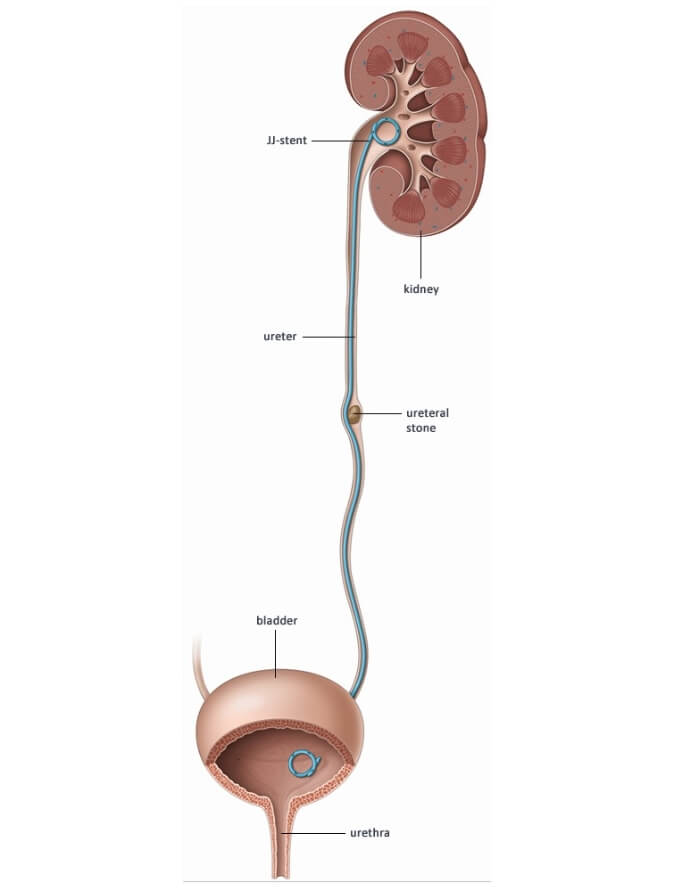
It is common to have DJ stenting inserted before and after treatment of ureteric or kidney stone. (please attach a photo of Double J stent)
Sometimes, DJ stent is inserted prior to stone surgery to bypass the blockage and allow ureter to dilate or expand before the definitive surgery. Some urinary discomfort is expected for patients with the stent. Some patients experience back pain when passing urine and some blood in urine is also expected. The discomfort is usually treatable with medications.
A flexible telescope with movable tip is used to treat kidney stones. Availability of modern surgical equipment such as high power laser allow more efficient treatment of large kidney stones
PCNL is the surgical removal of stones from the kidney. This is reserved for larger stones or stones that cannot be treated with either ureteroscopy or shock wave lithotripsy. A general anaesthetic is required and a small (1cm) incision is made in the skin overlying the kidney. A telescope is then introduced through this incision into the kidney. The stone is broken and removed. At the end of the procedure a small tube is left in the kidney, which drains out through the skin. This is normally removed after 48 hours.
Combination of PCNL and RIRS in the same setting allows safer treatment of large and complex kidney stones.
Certain kidney and ureteric stones might be too big to be treated endoscopically. Traditionally this is treated with open kidney or ureteric surgery. Introduction of laparoscopy and robotic surgery allows minimally invasive treatment of such cases.
Kidney stones are increasingly common and unfortunately can be very painful. It is important to confirm the diagnosis as well as a knowledge of the number, size and location of the stone or stones. This is important to allow us an individualized treatment for each patient.
Sometimes treatment for kidney stones can be managed without the need for surgical intervention by adapting diet and activity which will allow the stone to pass by itself in your urine.
To ease your symptoms, you are advised to:
- drink plenty of fluids throughout the day, by taking in up to 3 litres of fluid throughout the day, every day, until the stones have cleared.
- take painkillers.
- alpha-blockers (medicines to help stones pass) - also known as medical expulsion therapy. Please consult your urologist to understand more on this treatment.
Make sure you're drinking enough fluid. If your pee is dark yellow, it means you're not drinking enough. Your pee should be light yellow in colour. It is advisable to maintain this much of fluid to prevent future stone recurrence.
Shock wave lithotripsy involves treating a stone in the kidney or ureter without the need for a general anaesthesia. The patient lies on a bed and a water filled cushion is then pressed up against the kidney and shock wave is fired directed at the stone. This fragments the stone allowing the patient to pass the fragments. Analgesia is usually given before start of procedure and it is usually an outpatient procedure. The success rate from lithotripsy is also slightly lower than ureteroscopy and lasering the stone.
Ureteroscopy involves the insertion of a very small telescope up through the urine passage to the bladder and then up the ureter. This is performed under general anesthesia. A straight or semi-rigid telescope is normally used for stones in the ureter. A flexible telescope with a movable tip is used to access stones in the kidney. A laser fibre can be inserted down the middle of the telescope to allow the stone to be broken. A tiny wire basket may then be used to remove the stone fragments. Very small fragments may be left to pass out on their own. Ureteroscopy is the most successful way of treating stones of 15mm or less, but does require a general anesthesia.
It is common to have DJ stenting inserted before and after treatment of ureteric or kidney stone. (please attach a photo of Double J stent)
Sometimes, DJ stent is inserted prior to stone surgery to bypass the blockage and allow ureter to dilate or expand before the definitive surgery. Some urinary discomfort is expected for patients with the stent. Some patients experience back pain when passing urine and some blood in urine is also expected. The discomfort is usually treatable with medications.
A flexible telescope with movable tip is used to treat kidney stones. Availability of modern surgical equipment such as high power laser allow more efficient treatment of large kidney stones
PCNL is the surgical removal of stones from the kidney. This is reserved for larger stones or stones that cannot be treated with either ureteroscopy or shock wave lithotripsy. A general anaesthetic is required and a small (1cm) incision is made in the skin overlying the kidney. A telescope is then introduced through this incision into the kidney. The stone is broken and removed. At the end of the procedure a small tube is left in the kidney, which drains out through the skin. This is normally removed after 48 hours.
Combination of PCNL and RIRS in the same setting allows safer treatment of large and complex kidney stones.
Certain kidney and ureteric stones might be too big to be treated endoscopically. Traditionally this is treated with open kidney or ureteric surgery. Introduction of laparoscopy and robotic surgery allows minimally invasive treatment of such cases.
Get in Touch Today
Walk in appointments are available. In case of an emergency, please attend our Emergency Department. There is 24 hours medical support.
Call Us: +607 560 1000 extn 3009
Email: allen_sim@hotmail.com
Whats App Only: +6012 8876 783

