
Prostate Cancer
Magnetic resonance imaging (MRI) is a type of scan that uses strong magnetic fields and radio waves to produce detailed images of the inside of the body. An MRI scanner is a large tube that contains powerful magnets. You lie inside the tube during the scan which can take from 30 minutes to an hour depending on the amount of scanning required.
Multiparametric MRI prostate is an advanced imaging using sophisticated software that provides a more accurate overview of prostate and has much higher diagnostic accuracy compared to normal MRI prostate. There is no radiation involved.
If an mpMRI scan identifies areas for concern, here at Allen Sim Urology, we follow this up with biopsies of the prostate.
Template guided prostate biopsies or template prostate mapping (TPM) is performed as a day-case under a short general anaesthetic with the procedure taking 30-40 minutes. There can be some mild bruising afterwards but the risk of infection is greatly reduced using this approach.
Here at Allen Sim Urology, we have moved away from the conventional trans-rectal approach (TRUS biopsy). However in contrast to TPM this method can miss cancer in certain area of prostate and can result in a urinary infection in 3-5% despite antibiotics.
A step further is MRI Fusion Prostate Biopsies which combines the accuracy and precision benefits of multiparametric MRI and real time fusion of MRI and intraoperative ultrasound images to allow us to selectively biopsy area of suspicion. This way, we are no longer 'blindly' biopsying the prostate and hope that we get the cancer cells by chance. We will be able to confidently visualize and obtain tissues from area of suspicions identified on mpMRI. This has certainly improved the diagnostic accuracy of prostate biopsies alleviating the need for repeat biopsies and anxiety of living with possibility of prostate cancer.
Active surveillance is a form of treatment of prostate cancer whereby your prostate cancer is placed under strict follow up and treatment is offered if any evidence of progression or patient's choice. The aim is to delay or avoid the complications related to prostate cancer treatment.
You may be offered active surveillance if your prostate cancer is localised, deemed to be of a low risk and it is felt that you are unlikely to benefit from treatment. Generally the prostate cancer should be of a low grade (Gleason score 6 or less, sometimes expressed as Gleason score of 3+3) and your PSA stable and under 10 micrograms per litre. Active surveillance has been shown to be a safe strategy over many years.
The key is accurate risk classification at the onset. This usually involves MRI scans of the prostate and prostate template biopsies so that we can have a 95% certainty that the disease we think we are treating is indeed the disease that exists within the prostate.
Once the baseline is established, active surveillance is what it says. At regular intervals the PSA is checked. MRI can be done every 12 – 24 months. A repeat biopsy is done at 18-24 months. Definitive treatment can be offered at anytime during active surveillance if there is evidence of progression or patient.
Many men on active surveillance choose to optimise their weight, increase their exercise and sometimes change their diet. There is some evidence that some or all of these lifestyle changes do result in slower progression of prostate cancer.
Advantages:
- no side effects associated with treatment of prostate cancer
- no interference with activities of daily living
Disadvantages:
- Anxiety - Some men may worry about the cancer changing/progressing
- strict follow up protocol needs to be adhered to - regular blood test and DRE, MRI prostate and biopsies at fixed interval.
This is removal of the whole prostate gland together with the seminal vesicles in the treatment of localised prostate cancer. The procedure is performed through a number of small skin incisions using a ‘key-hole’ or laparoscopic approach or with a robot assisted laparoscopic approach.
Radical prostatectomy is one of the most established treatments for prostate cancer. It has evolved over the years from open surgery, into laparoscopic (LRP) and robotic assisted laparoscopic (RALP). It has been shown to have the best outcoming term of cancer control from all available treatment options.
The operation normally requires a general anesthesia and a short 2-3 day inpatient stay. A catheter will also be inserted which is normally removed after 1 – 2 weeks.
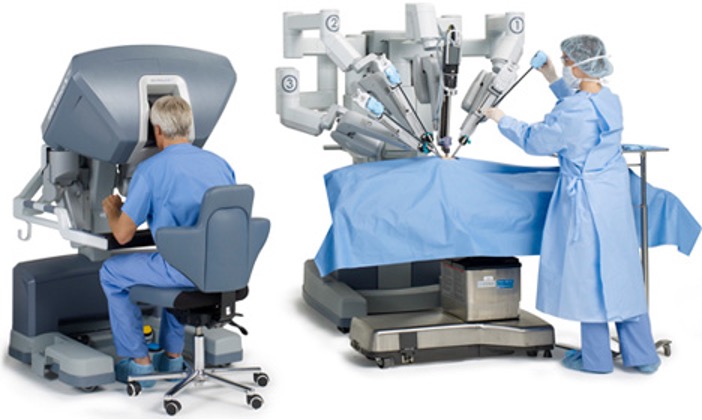
The operation is performed using a keyhole technique and may utilise the da Vinci Robot to aid the surgeon. Through small incisions a special 3D camera and arms are placed into the pelvis, which are then controlled by the surgeon. This set-up offers a very high definition view of the prostate and surrounding structures, along with highly accurate movements within the body allowing the prostate, seminal vesicles (tubes which help produce semen) and occasionally lymph nodes to be removed.
The laparoscopic method has revolutionized radical prostatectomy as it has led to a significant reduction in blood loss and reduced the length of hospital stay for the patient over open surgery.
As it is the only procedure where the entire prostate along with the cancerous area is removed, the PSA will normally drop to an undetectable level. Unfortunately, as with all cancer, recurrence is possible and initially your PSA will be monitored on a 3 monthly basis.
Cancer control outcomes are dependent on the risk stratification of disease being treated. On average 98% of men are still alive 10 years after their surgery, with 75% of men having no evidence of biochemical recurrence (rising PSA).
Side-effects are the main limiting factor of radical prostatectomy. Initial incontinence is present in the majority of men but this normally improves over the first 1-4 months and by 12 months more than 95% of men are completely dry. Pelvic floor exercises can be performed to speed up the recovery of full continence and a pad may need to be worn until continence is achieved.
Erections are also effected in 40 – 60% of men. This is dependent on age as well as whether erections were present before the operation.
The nerves to the penis surrounding the prostate on both sides may be damaged. It is possible to spare one or both of these when performing the operation and these patients have the best chance of regaining their erections. However occasionally, to ensure that all the cancer is removed, both nerves have to be removed with a wide margin taken around the prostate.
If erectile dysfunction does occur after surgery than it can be treated with either tablets (PDE5 inhibitors), or injections.
External beam radiotherapy uses high energy X-ray beams to treat prostate cancer. The X-ray beams are directed at the prostate gland from outside the body. The X-rays aim to destroy the cancer cells in the area they target. They are administered in small doses (fractions) over several days, usually Monday to Fridays.
Radiotherapy treats the whole prostate and a small area around it. The treatment is painless but it can cause side effects.
Advantages of Radiotherapy
- It is an outpatient treatment
- daily activities are rarely affected
- Radiotherapy can be used to attempt to cure the disease even if you’re not fit or well enough for surgery.
Disadvantages of Radiotherapy
- You will need to go to hospital five days a week for 6-7 weeks. This might be difficult if you live far away from the hospital.
- Radiotherapy may cause side effects as shown below
- If you have radiotherapy as your first treatment and your cancer comes back or spreads, surgery might be challenging.
Side Effects of Radiotherapy
The side effects of radiotherapy are divided into those that can occur during radiotherapy and those that can occur many months or years after radiotherapy. During radiotherapy you may notice:
- Tiredness (Fatigue)
- Discomfort in rectum or anus (back passage)
- Difficulty in passing water
- Skin irritation or breakdown (uncommon)
- Permanent and patchy pubic hair loss
- Frequency of urine, inflammation of and bleeding from the bladder (cystitis)
- A desire to pass motions and flatulence more frequently
- Diarrhoea
Late effects of radiotherapy may take many months or years after treatment to happen. They include:
- Bleeding from the back passage
- blood in the urine
- Urgency of bowel movements
- Increased urinary frequency because the bladder is smaller or due to narrowing of urine tube(urethra)
- Impotence (in about 60% of men)
- Infertility
- There is a risk of second malignancy with radiotherapy but this is very rare and would not usually occur until 15-20 years after treatment.
Magnetic resonance imaging (MRI) is a type of scan that uses strong magnetic fields and radio waves to produce detailed images of the inside of the body. An MRI scanner is a large tube that contains powerful magnets. You lie inside the tube during the scan which can take from 30 minutes to an hour depending on the amount of scanning required.
Multiparametric MRI prostate is an advanced imaging using sophisticated software that provides a more accurate overview of prostate and has much higher diagnostic accuracy compared to normal MRI prostate. There is no radiation involved.
If an mpMRI scan identifies areas for concern, here at Allen Sim Urology, we follow this up with biopsies of the prostate.
Template guided prostate biopsies or template prostate mapping (TPM) is performed as a day-case under a short general anaesthetic with the procedure taking 30-40 minutes. There can be some mild bruising afterwards but the risk of infection is greatly reduced using this approach.
Here at Allen Sim Urology, we have moved away from the conventional trans-rectal approach (TRUS biopsy). However in contrast to TPM this method can miss cancer in certain area of prostate and can result in a urinary infection in 3-5% despite antibiotics.
A step further is MRI Fusion Prostate Biopsies which combines the accuracy and precision benefits of multiparametric MRI and real time fusion of MRI and intraoperative ultrasound images to allow us to selectively biopsy area of suspicion. This way, we are no longer 'blindly' biopsying the prostate and hope that we get the cancer cells by chance. We will be able to confidently visualize and obtain tissues from area of suspicions identified on mpMRI. This has certainly improved the diagnostic accuracy of prostate biopsies alleviating the need for repeat biopsies and anxiety of living with possibility of prostate cancer.
Active surveillance is a form of treatment of prostate cancer whereby your prostate cancer is placed under strict follow up and treatment is offered if any evidence of progression or patient's choice. The aim is to delay or avoid the complications related to prostate cancer treatment.
You may be offered active surveillance if your prostate cancer is localised, deemed to be of a low risk and it is felt that you are unlikely to benefit from treatment. Generally the prostate cancer should be of a low grade (Gleason score 6 or less, sometimes expressed as Gleason score of 3+3) and your PSA stable and under 10 micrograms per litre. Active surveillance has been shown to be a safe strategy over many years.
The key is accurate risk classification at the onset. This usually involves MRI scans of the prostate and prostate template biopsies so that we can have a 95% certainty that the disease we think we are treating is indeed the disease that exists within the prostate.
Once the baseline is established, active surveillance is what it says. At regular intervals the PSA is checked. MRI can be done every 12 – 24 months. A repeat biopsy is done at 18-24 months. Definitive treatment can be offered at anytime during active surveillance if there is evidence of progression or patient.
Many men on active surveillance choose to optimise their weight, increase their exercise and sometimes change their diet. There is some evidence that some or all of these lifestyle changes do result in slower progression of prostate cancer.
Advantages:
- no side effects associated with treatment of prostate cancer
- no interference with activities of daily living
Disadvantages:
- Anxiety - Some men may worry about the cancer changing/progressing
- strict follow up protocol needs to be adhered to - regular blood test and DRE, MRI prostate and biopsies at fixed interval.
This is removal of the whole prostate gland together with the seminal vesicles in the treatment of localised prostate cancer. The procedure is performed through a number of small skin incisions using a ‘key-hole’ or laparoscopic approach or with a robot assisted laparoscopic approach.
Radical prostatectomy is one of the most established treatments for prostate cancer. It has evolved over the years from open surgery, into laparoscopic (LRP) and robotic assisted laparoscopic (RALP). It has been shown to have the best outcoming term of cancer control from all available treatment options.
The operation normally requires a general anesthesia and a short 2-3 day inpatient stay. A catheter will also be inserted which is normally removed after 1 – 2 weeks.
The operation is performed using a keyhole technique and may utilise the da Vinci Robot to aid the surgeon. Through small incisions a special 3D camera and arms are placed into the pelvis, which are then controlled by the surgeon. This set-up offers a very high definition view of the prostate and surrounding structures, along with highly accurate movements within the body allowing the prostate, seminal vesicles (tubes which help produce semen) and occasionally lymph nodes to be removed.
The laparoscopic method has revolutionized radical prostatectomy as it has led to a significant reduction in blood loss and reduced the length of hospital stay for the patient over open surgery.
As it is the only procedure where the entire prostate along with the cancerous area is removed, the PSA will normally drop to an undetectable level. Unfortunately, as with all cancer, recurrence is possible and initially your PSA will be monitored on a 3 monthly basis.
Cancer control outcomes are dependent on the risk stratification of disease being treated. On average 98% of men are still alive 10 years after their surgery, with 75% of men having no evidence of biochemical recurrence (rising PSA).
Side-effects are the main limiting factor of radical prostatectomy. Initial incontinence is present in the majority of men but this normally improves over the first 1-4 months and by 12 months more than 95% of men are completely dry. Pelvic floor exercises can be performed to speed up the recovery of full continence and a pad may need to be worn until continence is achieved.
Erections are also effected in 40 – 60% of men. This is dependent on age as well as whether erections were present before the operation.
The nerves to the penis surrounding the prostate on both sides may be damaged. It is possible to spare one or both of these when performing the operation and these patients have the best chance of regaining their erections. However occasionally, to ensure that all the cancer is removed, both nerves have to be removed with a wide margin taken around the prostate.
If erectile dysfunction does occur after surgery than it can be treated with either tablets (PDE5 inhibitors), or injections.
External beam radiotherapy uses high energy X-ray beams to treat prostate cancer. The X-ray beams are directed at the prostate gland from outside the body. The X-rays aim to destroy the cancer cells in the area they target. They are administered in small doses (fractions) over several days, usually Monday to Fridays.
Radiotherapy treats the whole prostate and a small area around it. The treatment is painless but it can cause side effects.
Advantages of Radiotherapy
- It is an outpatient treatment
- daily activities are rarely affected
- Radiotherapy can be used to attempt to cure the disease even if you’re not fit or well enough for surgery.
Disadvantages of Radiotherapy
- You will need to go to hospital five days a week for 6-7 weeks. This might be difficult if you live far away from the hospital.
- Radiotherapy may cause side effects as shown below
- If you have radiotherapy as your first treatment and your cancer comes back or spreads, surgery might be challenging.
Side Effects of Radiotherapy
The side effects of radiotherapy are divided into those that can occur during radiotherapy and those that can occur many months or years after radiotherapy. During radiotherapy you may notice:
- Tiredness (Fatigue)
- Discomfort in rectum or anus (back passage)
- Difficulty in passing water
- Skin irritation or breakdown (uncommon)
- Permanent and patchy pubic hair loss
- Frequency of urine, inflammation of and bleeding from the bladder (cystitis)
- A desire to pass motions and flatulence more frequently
- Diarrhoea
Late effects of radiotherapy may take many months or years after treatment to happen. They include:
- Bleeding from the back passage
- blood in the urine
- Urgency of bowel movements
- Increased urinary frequency because the bladder is smaller or due to narrowing of urine tube(urethra)
- Impotence (in about 60% of men)
- Infertility
- There is a risk of second malignancy with radiotherapy but this is very rare and would not usually occur until 15-20 years after treatment.
Get in Touch Today
Walk in appointments are available. In case of an emergency, please attend our Emergency Department. There is 24 hours medical support.
Call Us: +607 560 1000 extn 3009
Email: allen_sim@hotmail.com
Whats App Only: +6012 8876 783

